
Why does "good for a small home office" get treated as though it means the same thing as "good for a small person"? I've seen that mix-up baked into more ergonomic-seating roundups than I can count, and untangling it is basically the reason I ended up buying a Herman Miller Sayl instead of grabbing another mesh chair off a big-box shelf.
Quick disclosure before we go further: the specific chairs linked below are affiliate-tracked, so if you buy through one, I earn a commission at no extra cost to you. Nothing here is a sponsored placement. It's stuff I've actually sat in, in a home office that still doubles as toddler-gear storage on bad days.
The Small-Footprint Myth in Ergonomic Seating
Here's the myth, spelled out: if a chair looks compact — thin profile, no bulky headrest, doesn't visually eat the room — it must also be sized for a compact person. Those are two separate measurements getting flattened into one marketing sentence. Herman Miller only builds the Sayl in one frame, and that single frame runs small, which flips the usual sizing question on its head: instead of picking which size to order, you're asking whether the chair fits you at all — the inverse of shopping for an Aeron. A reader named Destiny Hawkins emailed me a while back, after a piece I'd written about quitting cheap office chairs, pointing out that most "best ergonomic chair" lists quietly assume a body over five-foot-eight. She's stayed a regular correspondent since. True to form for her, she kept the first chair she tried without shopping around further, which says more about her patience than it does about any chair's universal fit. The honest answer I gave her about the Sayl had nothing to do with how small it looks in a room. Footprint and fit just aren't the same question.
A Frameless Back Solves a Room Problem, Not a Body Problem
My office is a converted second bedroom, not a proper suite, and every prior chair felt like parking a small appliance in a room that didn't have space for one. What actually solves that problem is the frameless backrest: no rigid plastic perimeter holding the mesh taut, just a "Y-Tower" spine running up the center, an idea Herman Miller has said was influenced by the suspension-cable engineering on the Golden Gate Bridge. Because the back is translucent and flexes at the edges, it doesn't read as a wall of black mesh in a room where every piece of furniture is already negotiating for square footage. That's a real improvement for a cramped office. It isn't evidence the chair fits a smaller person, though, which is exactly the substitution the myth keeps making.
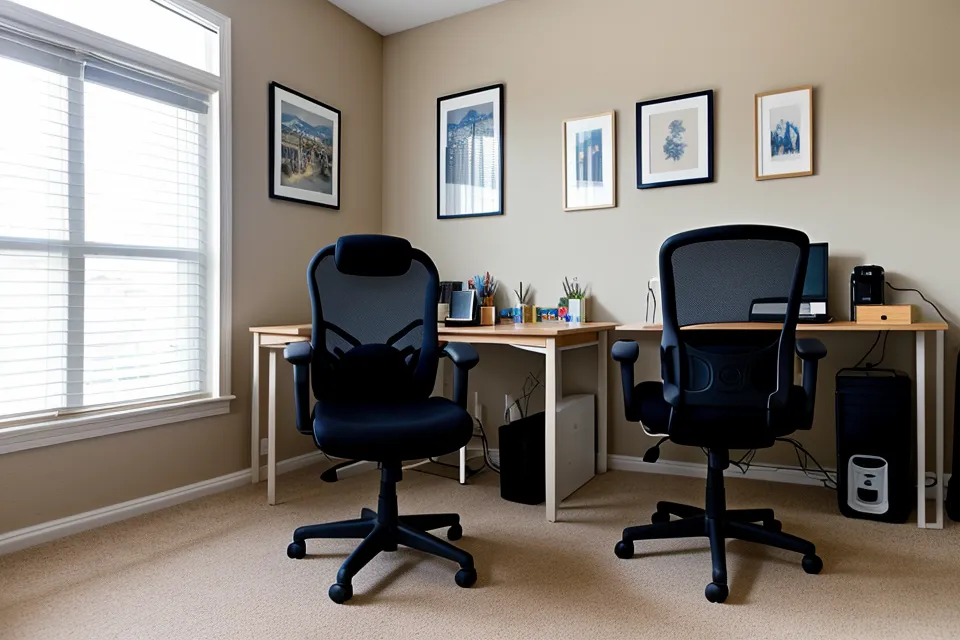
That edge-flex costs you something, and it's worth naming since I don't want to oversell the Sayl the way the marketing copy does. The lumbar support is noticeably less assertive than what you get from a rigid-frame chair like the Steelcase Gesture or the Aeron. I've covered lumbar support properly, at the depth that matters if you're dealing with sciatica rather than garden-variety desk fatigue, in a separate piece on choosing a chair for lower-back pain, so I won't re-litigate the mechanics here. For a small office specifically, less aggressive lumbar support paired with a smaller room actually makes sense: you're not fighting the chair for space every time you lean over a crowded desk.
What Does the Sayl Skip to Stay This Small?
Before the Sayl, I lived with a Branch Ergonomic Chair for a stretch, and the lumbar dial on that one felt like flipping a coin. Sometimes more support, sometimes less, never anything I could repeat on purpose. That's a fair trade for the price, and I don't think Branch pretends otherwise. What it meant for me, practically, was reaching for ibuprofen most Thursdays and Fridays just to get through the week without my shoulders locking up. That's not a fix. It's a workaround, and I should have clocked that sooner. Herman Miller backs the Sayl with a twelve-year warranty that covers the gas cylinder, the part that actually fails first on most chairs, and whether that length of warranty is a real durability signal or mostly a marketing flex is a comparison I've run properly elsewhere — the same instinct as paying more for a kitchen appliance built to outlast the cheap one you keep replacing. Short version: it's one data point, not the whole picture, and it doesn't automatically justify the price tag by itself.
The adjustment levers themselves took real effort to learn, nothing like the more intuitive knobs on some Steelcase models. It was closer to trial and error until something finally sat right against my back. PostureFit SL does most of that work, and I'll spare you the anatomy lecture; what matters here is that getting it right took patience, not luck.
Seat-depth adjustment is a related feature the Sayl skips almost entirely, and it matters more on long workdays than most people expect, enough that it deserves its own dedicated comparison rather than a footnote here. Same goes for the armrests: height-only, no pivot, no width tweak, which is a real limitation if you've dialed in armrest configuration on chairs built with more axes to play with. The recline tension dial needed calibrating too, and if your shoulders are the actual problem rather than your lower back, my notes on adjusting a chair for shoulder support cover that fix specifically, since it's different from anything else in this piece.

One Tuesday afternoon stands out more than the rest. Around four, I realized I hadn't once reached back to knead my own shoulder, a reflex that had gotten so automatic on other chairs that I'd stopped noticing I did it. Nothing dramatic happened. I just hadn't needed to.
Can a Frameless Mesh Chair Survive an Actual Family Office?
Summers here get genuinely swampy, and a fully upholstered seat turns into a heat sponge by early afternoon. The Sayl's open-weave back and seat let air move instead of trapping it, which matters more in a small room than a large one, since a cramped office heats up faster to begin with. I've also spent time in a Branch chair since, and in some of the Design Within Reach lineup, and neither breathes as well as the Sayl's elastomer does when the air conditioning is losing the argument. That same elastomer shrugs off toddler chaos better than I expected: crushed crackers, a juice spill, an occasional mystery smear, none of it left a mark, roughly the same standard you'd want from a washable rug rated for that kind of abuse. It holds a 350-pound rider despite how slight the frame looks, and the suspension material itself — elastomer versus mesh versus foam — matters more than people assume. I've run a longer material-by-material comparison between the Gesture and the Embody elsewhere if you want that full breakdown instead of the one-line version here.
The Real Small-Office Verdict on the Sayl
Line the regulars up against each other and the differences are less about quality and more about which trade-off you want. The Sayl wins on visual lightness and narrow-desk clearance, and that 350-pound capacity in such a small-looking frame still surprises people. The Steelcase lineup generally flexes more through the backrest but takes up more visual space in a 10-by-10 room, worth knowing if fabric appeals to you more than elastomer. Branch is worth considering if you're furnishing an entire office at once on a tighter budget, though its warranty runs shorter than the industry leaders. None of these three answer the monitor-height question or the standing-desk question, for what it's worth. Eye-level monitor positioning and a desk's actual height range are separate purchases with their own separate rabbit holes, and no chair, however well suited to a small room, fixes either one for you.
My neighbor Jacinda Wehr, two doors down, will insist premium chair brands are a waste of money right up until her own back forces a rethink, which is basically the whole myth from this piece compressed into one person. The Sayl isn't the plushest option out there. If cushioned softness is what you actually want for downtime rather than a workday, a Lovesac Sactional solves a different problem entirely, and its modular pieces reconfigure in a way no office chair ever will, more of a living-room conversation than anything covered here. For an actual small office where every inch of floor gets negotiated between a desk, a toddler's toy bin, and whatever storage got exiled from the rest of the house, the Sayl earns its keep specifically because its size problem and its fit problem are two separate, solvable questions, not because it's automatically the right size for you.
So here's the actual rule, if you want one: judge the Sayl's size on desk clearance and how much visual weight it adds to your room, and judge the fit — whether it suits your particular height and build — as a completely separate question, ideally by sitting in one before you buy rather than trusting marketing photos. Treat those as one decision and you'll end up guessing. Treat them separately and the guesswork mostly disappears.
If you're weighing the Sayl against the rest of this list for your own small office, the breakdown below has the specifics on where each one lands. Worth a look before you commit to a chair you can't test-sit first.
| Product | Rating | |
|---|---|---|
| Herman Miller Editor's Pick | 9.2 | Read More → |
| Steelcase | 8.8 | Read More → |
| Branch | 8.4 | Read More → |
| Design Within Reach | 8.1 | Read More → |
| Lovesac | 7.9 | Read More → |
Herman Miller
Pros
- + Space-saving frameless design doesn't overwhelm small rooms
- + 12-year warranty covers the high-failure parts like the gas cylinder
- + Elastomer back stays cool during humid North Carolina summers
- + High 350-pound weight capacity in a compact frame
Cons
- ✘ Adjustment levers take a full workweek to really master
- ✘ Lumbar support is less aggressive than rigid-frame models