The chair that finally sent me down this rabbit hole was a $180 mesh thing that looked fine in the photos and had my shoulders locked up by every Friday afternoon. I returned the one after that too — the armrests pinched my elbows every time I pulled up to the desk. So before I caved on anything expensive, I built myself this comparison: the adjustments that actually matter for an all-day video-call chair, the real weight ratings, and the warranty each brand will actually stand behind. Every number here I pulled from the manufacturer's own spec page or a teardown review that lists them — sources linked in each row, not "trust me."
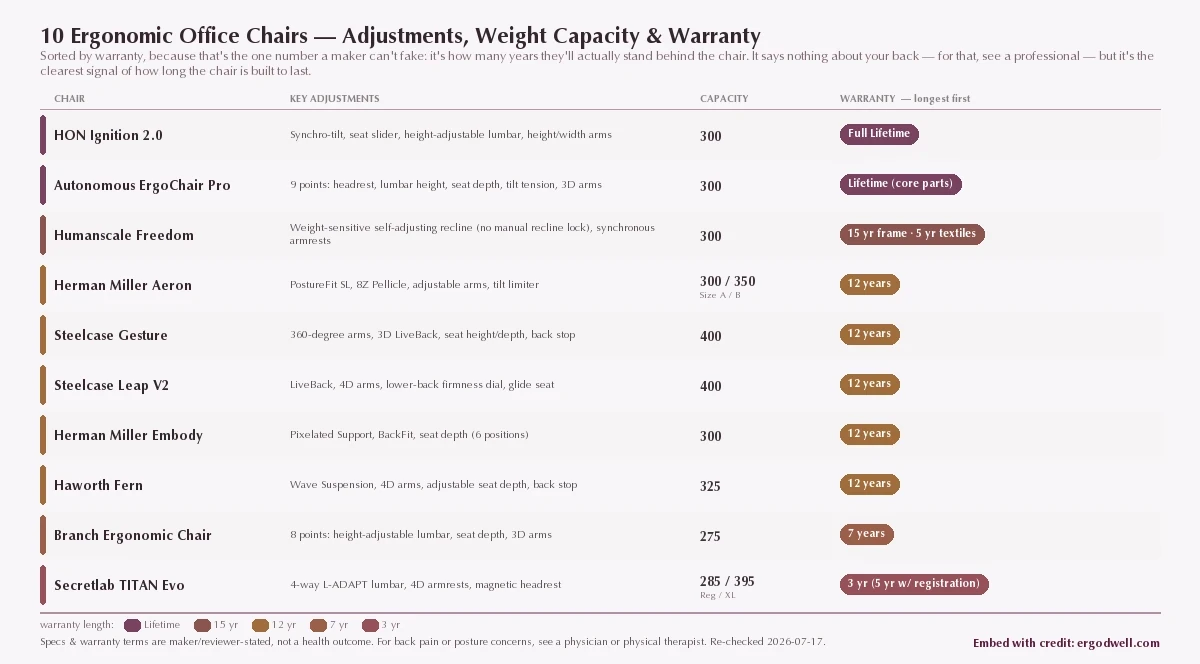
Ergonomic Chair Comparison Table
| Model | Primary Adjustments | Weight Capacity (lbs) | Warranty Period |
|---|---|---|---|
| Herman Miller Aeron | 8Z Pellicle suspension, PostureFit SL (sacral/lumbar), fully adjustable arms, tilt limiter with seat angle (Source) | 300 (Size A), 350 (Size B) (Source) | 12 Years (Source) |
| Steelcase Gesture | 360-degree arms, 3D LiveBack, seat height/depth, variable back stop (Source) | 400 (Source) | 12 Years (Source) |
| Steelcase Leap V2 | LiveBack technology, 4D arms, lower back firmness dial, natural glide seat (Source) | 400 (Source) | 12 Years (Source) |
| Herman Miller Embody | Pixelated Support, BackFit adjustment, seat depth (6 locking positions), 3-position tilt limiter (Source) | 300 (Source) | 12 Years (Source) |
| Haworth Fern | Wave Suspension System, 4D arms, adjustable seat depth, back stop (Source) | 325 (Source) | 12 Years (Source) |
| Humanscale Freedom | Weight-sensitive self-adjusting recline (no manual recline lock), synchronous armrests, dynamic headrest (Source) | 300 (Source) | 15 Years (frame/mechanism), 5 Years (textiles/cushions) (Source) |
| Secretlab TITAN Evo | 4-way L-ADAPT lumbar, 4D armrests, magnetic headrest, 85–165 degree recline (Source) | 285 (Regular), 395 (XL) (Source) | 3 Years (extendable to 5 with registration) (Source) |
| HON Ignition 2.0 | Synchro-tilt mechanism, seat slider, height-adjustable lumbar, height/width arms (Source) | 300 (Source) | Full Lifetime (Source) |
| Branch Ergonomic Chair | Eight points of adjustment including height-adjustable lumbar, seat depth, and 3D armrests (Source) | 275 (Source) | 7 Years (Source) |
| Autonomous ErgoChair Pro | 9 points of adjustment including headrest, lumbar height, seat depth, tilt tension, and 3D armrests (Source) | 300 (Source) | Lifetime (core components) (Source) |
What the adjustment jargon actually means
Half the spec sheets read like a physics exam, so here's the plain-language version of what I was actually shopping for:
- Synchro-Tilt
- The backrest and seat recline together at a fixed ratio (often 2:1) — so you can lean back without your feet leaving the floor. It's the difference between "reclining" and "tipping over backward like the kid's high chair."
- 4D Armrests
- Armrests that move four ways: up/down, in/out, forward/back, and pivot. These are the ones that stopped pinching my elbows — cheaper chairs usually give you height only, if that.
- Seat Depth (Seat Slider)
- Slides the seat pan forward or back so the edge doesn't cut into the back of your knees. Matters a lot more if you're short or tall than the marketing lets on.
- Lumbar Support (Sacral/Lumbar)
- Support for your lower spine. The good systems let you set height, depth, or firmness instead of one fixed bump that never lands where your back actually curves.
- Tilt Limiter / Back Stop
- A control that caps how far the chair leans back, so you can lock it upright for typing and open it up for the long "why is this meeting still going" stretches.
One honest note: I'm a remote worker who's returned a lot of chairs, not a physical therapist. This page is furniture research for general information, not medical advice — if your back or shoulders are genuinely acting up, see a physician or a licensed physical therapist before betting on any chair to fix it. Every spec above was checked against the linked source on 2026-07-29.
Sources
- BTOD — Herman Miller Aeron Review & Specifications
- Steelcase Gesture — Official Product Page
- Steelcase Leap — Official Product Page
- Seated Lab — Herman Miller Embody Review
- Haworth — Fern Office Chair Product Page
- Humanscale — Freedom Headrest Executive Chair
- Humanscale — Warranty Terms & Conditions
- ChairsFX — Secretlab TITAN Evo Review
- Seated Lab — HON Ignition 2.0 Review
- Branch — Ergonomic Chair Product Page
- Autonomous — ErgoChair Pro Product Page